


How AI is Transforming the Finance Industry: Trends, Challenges, and Opportunities
After years of steady development, artificial intelligence (AI) now propels previously unheard-of levels of innovation in a variety of sectors. Previously a cautious and regulated industry, the banking sector is now using AI for customer service, risk management, fraud detection, predictive analytics, and compliance. Although AI use in finance is accelerating, there are also a lot of potential and challenges associated with it.
Until 2021, financial institutions were thought to be slower than other industries at implementing AI. This latency was caused by a lack of personnel with expertise in artificial intelligence, infrastructural constraints, and worries about regulatory compliance. But in 2023, generative artificial intelligence (Gen AI) and large language models (LLMs) emerged, signaling a sea change.
According to IDC market research, global AI spending on hardware and services is projected to surpass $500 billion by 2027. Additionally, financial service firms are expected to double their AI investments, as noted by the International Monetary Fund (IMF). AI is revolutionary because of its capacity to reduce human error, evaluate enormous datasets, forecast financial trends, and expedite document processing. But even with these developments, worries about potential financial crises, fraud powered by AI, and cybersecurity risks are still very real. The industry must strike a balance between innovation, security, and compliance as AI integration increases.
Leading financial professionals discuss how artificial intelligence (AI) is changing the financial environment, the dangers associated, and ways to use AI-driven solutions while avoiding potential problems in this article.
How is Artificial Intelligence Transforming the Financial Industry?
Organizations are using large language models (LLMs) and artificial intelligence (AI) more and more to improve customer service, identify fraudulent activity, and expedite complicated, data-intensive operations. The financial industry is currently quickly adopting these technologies to obtain a competitive edge, despite their initial slow uptake.
When companies like BlackRock incorporated AI, the finance sector saw a dramatic change, forcing rivals to either adapt or face extinction, according to Salas, an expert in AI and machine learning. BlackRock integrated AI-driven solutions into its business in 2023 to improve customer experiences, hone investment strategies, and spur technical advancement.
The benefits of artificial intelligence (AI) in finance, such as increased operational effectiveness and data-driven decision-making, are widely known. But because of obstacles like updating outdated systems, integrating AI seamlessly into financial models, and certain legal issues, some investment firms are still apprehensive. Notwithstanding these challenges, moving toward financial solutions driven by AI is becoming crucial for maintaining an advantage in a changing market. Numerous earlier obstacles have been removed in part by ChatGPT's explosive growth and the growing acceptability of AI in society. Skepticism has drastically decreased as companies see actual success stories and the observable advantages of implementing AI. Salas claims that regulatory agencies are now more receptive to AI-powered financial solutions, hastening the industry's adoption of these solutions. However, many financial institutions are taking a cautious, wait-and-see approach before completely committing to AI-powered initiatives because of the ongoing hurdles posed by loopholes in current rules.
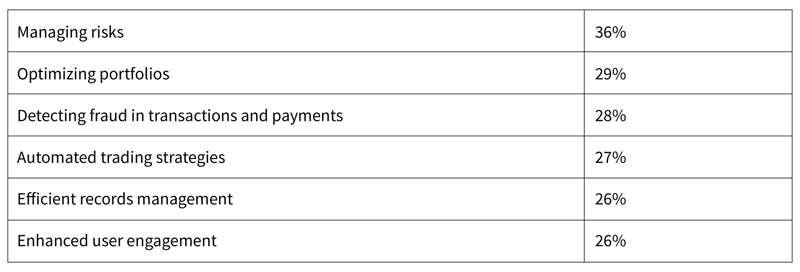
Top AI Use Cases Businesses Are Prioritizing Today
A global survey of nearly 400 financial services professionals reveals key applications shaping the industry.
4 Key Areas Where AI is Revolutionizing Finance
The financial sector is changing due to artificial intelligence (AI), which provides previously unheard-of levels of accuracy, efficiency, and strategic insights. AI-powered solutions revolutionize the operations of financial institutions, from risk management to data processing. AI is having a big impact in the following four crucial areas:
1. Smarter Data Parsing and Insights Extraction
More than two-thirds of the vast amounts of data that financial institutions gather are never used. By effectively categorizing, evaluating, and drawing conclusions from enormous datasets that were previously too complicated for human processing, AI-powered solutions are revolutionizing this.
Machine learning algorithms, in contrast to conventional automation technologies, can identify patterns, make decisions based on data, and get better over time. This is particularly useful for contract analysis and loan processing. Natural language processing (NLP) is used, for example, by JPMorgan Chase's COIN (Contract Intelligence Platform) to extract important data from commercial loan agreements. The review process took over 360,000 hours a year before AI integration; today, AI completes the task in a matter of seconds with increased efficiency and accuracy.
Furthermore, by examining intricate situations, AI models such as ChatGPT and Google Gemini allow financial experts to investigate market patterns, investment plans, and risk evaluations. AI-generated insights offer a solid basis for quicker and better-informed decision-making, but they also need human validation.
2. AI-Driven Portfolio Optimization for Smarter Investing
AI is being used by investment firms to improve real-time market analysis and portfolio management. Large language models (LLMs), in contrast to conventional trading algorithms, are capable of processing unstructured financial data, seeing patterns, and making dynamic predictions about market trends.
Renaissance Technologies' Medallion Fund, which used sophisticated algorithms to profit on microsecond-level price fluctuations and generated an incredible 63.3% return between 1998 and 2018, is a pioneering example of AI-driven trading success. AI has advanced this strategy in the modern era. Unlike general-purpose AI models like GPT-4, BlackRock, a worldwide investment management organization, has integrated specialized AI models designed for investment strategies.
Because BlackRock's AI is educated on limited financial datasets, it can more precisely extract insights from stock patterns, earnings calls, and market behaviors. Research indicates that these tailored AI models perform better than generic AI tools, demonstrating the usefulness of domain-specific AI in portfolio management.
3. AI-Powered Risk Management and Fraud Detection
Artificial intelligence is transforming risk assessment and fraud prevention by identifying irregularities in financial transactions that can indicate fraudulent conduct. Machine learning algorithms, which continuously track transaction trends and instantly indicate suspect activity, greatly decrease financial risks.
For example, to spot possible fraud attempts before they happen, Visa and Mastercard employ AI-based fraud detection systems that examine thousands of transactions every second. A safer digital transaction ecosystem has been ensured by these AI-driven models, which have cut fraud losses and false declines by more than 50%. AI Automation for Small Businesses is revolutionizing financial operations, helping companies streamline compliance and fraud detection with cutting-edge machine learning models. Additionally, by examining more data points than just traditional credit ratings, AI improves the assessment of credit risk. To make more accurate lending decisions and lower the risk of loan defaults, banks are now using predictive analytics to evaluate a borrower's financial behavior.
4. Automating Financial Operations and Customer Support
Chatbots and virtual assistants driven by AI are revolutionizing banking customer service. AI-powered chatbots have been included by numerous financial institutions to answer questions, offer financial guidance, and even help with loan applications.
For instance, Erica, Bank of America's AI assistant, uses natural language interaction to assist users with account management, expenditure tracking, and personalized financial insights. Banks can lower operating expenses and enhance customer satisfaction by automating repetitive queries.
AI-Powered Web Development for Small Businesses enables fintech startups to integrate AI-driven customer service tools and automate routine financial operations, enhancing the overall customer experience. AI is also simplifying back-office financial functions, including invoice administration, tax processing, and regulatory compliance. Financial firms can improve compliance, decrease human error, and boost efficiency by automating these procedures.
Quinn asserts that smaller financial institutions can use AI technology since it can be implemented successfully and affordably on a smaller scale. Quinn talked about his experience testing an algorithm to maximize trade proposals. Quinn was the wealth management head of a fintech startup before helping it successfully exit to a large US bank. This algorithm took cash flow requirements and withdrawals into account while attempting to match portfolios with aims. "I would evaluate, accept, or reject the daily trade recommendations made by the algorithm. The AI was trained to predict whether a human would authorize a deal because to the useful dataset that was produced by this iterative process, explains Quinn.
Quinn is still using this AI technology at his current wealth management company, even though the startup was purchased before he could completely improve the product. Quinn's algorithms monitor regular transactions, such as monthly withdrawals or contributions, by examining data from custodial accounts. These trends aid in creating a training set that gives the AI the ability to forecast cash flows on its own without human assistance. This method, which emphasizes precise forecasts and smooth data integration, combines several algorithms with large language models (LLMs) to improve the client experience.
Leveraging AI for Compliance in Financial Services
The instruments that businesses use to stay in compliance with regulations must change as financial services continue to get more complicated. Financial crime identification and prevention is one important area where AI is having a big influence.
For instance, HSBC, a UK-based bank, resorted to artificial intelligence (AI) technology to improve its ability to identify suspect financial activities when it was discovered that it had laundered at least $20 billion for organized crime across 17 banks. To improve its fraud detection capabilities and more effectively identify transactions for additional examination, HSBC teamed up with the AI company Ayasdi. Additionally, to lessen the workload for human compliance officers, HSBC partnered with Silent Eight, an AI company that specializes in generative AI, to automate formerly manual processes like transaction monitoring, alert adjudication, and customer screening. HSBC attributes a 20% decrease in the number of investigations needed to their AI-driven approach to money laundering prevention. In addition to lowering operating expenses, this enhancement allowed compliance teams to devote more attention to high-risk cases. Additionally, by simplifying the procedure and reducing pointless reviews, the use of AI in transaction monitoring has dramatically reduced false positive rates.
The Rise of AI in Customer Service for Financial Institutions
Deep learning technologies are allowing AI-driven chatbots and virtual assistants to handle common questions and transactions on their own, changing customer service in the finance industry. These intelligent solutions improve the overall client experience by presenting comprehensive transaction histories, verifying account balances, and initiating payments through real-time interactions.
Erica, the chatbot from Bank of America, was among the first financial tools to use cutting-edge AI capabilities. When Erica first launched in 2018, it provided capabilities including fraud detection, proactive alerts, predictive insights, and individualized financial advice. It was a well-liked application because of its easy-to-use layout and frequent upgrades. Customers used Erica 56 million times a month by 2023 to manage subscriptions, examine spending patterns, keep tabs on goods refunds, and check their FICO scores. The financial services sector is seeing an increase in the deployment of robot assistants driven by AI. Notable instances include Sandi from Santander, NOMI from the Royal Bank of Canada, and Citi Bot SG from Citi. According to a Salesforce poll, 81% of banking customers now try to fix problems on their own using tools like chatbots before contacting human help, indicating that this expanding trend is in line with current customer expectations.
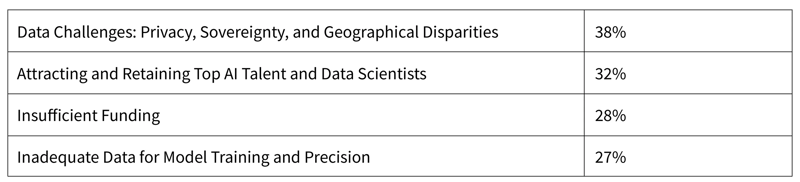
Key Challenges Companies Face in Achieving AI Success
A global survey of nearly 400 financial services professionals highlights the most significant obstacles organizations encounter when implementing AI-driven strategies:
Ensuring Strong Security in AI-Driven Finance
In the financial sector, where businesses handle enormous volumes of sensitive data, such as transaction logs, personal information, and proprietary company information, data security continues to be of utmost importance. It is now more important than ever to protect this data from cyberattacks and illegal access due to the growing use of AI in financial services. To reduce risks and guarantee regulatory compliance, it is crucial to put strong security measures in place, such as data encryption, safe storage, and stringent access controls.
"As we expand our AI and machine learning capabilities, we inevitably collect more data, which increases our exposure to potential security risks," explains Quinn. "Establishing a comprehensive data management and security policy is vital."
Strict compliance requirements for data privacy in AI-driven finance are enforced by international regulatory frameworks, including the General Data privacy Regulation (GDPR), the California Consumer Privacy Act (CCPA), and the recently passed EU AI Act. To avoid serious fines, financial institutions must implement AI-powered security solutions that comply with these regulations. While CCPA infractions can result in fines of $2,500 for unintentional breaches and $7,500 for willful ones, the GDPR imposes fines of up to €20 million, or 4% of a company's global annual revenue.
Maintaining High-Quality Data for AI Success
The caliber of the data used to train AI models has a direct impact on their efficacy. Businesses face a crucial difficulty in ensuring that this data is reliable, comprehensive, and devoid of anomalies. According to AI specialist Quinn, even the most sophisticated models have limitations, so ongoing data refining is crucial.
“It’s not just about developing an algorithm and assuming it will perform optimally forever,” Quinn explains. “AI systems must constantly update their parameters based on new training datasets and real-world observations to improve accuracy and effectiveness.”
Businesses must think about two key questions in order to accomplish this: How can we effectively gather data? How will we ensure data cleanliness? Optimizing machine learning performance, improving prediction accuracy, and promoting better decision-making in AI-powered applications depend on establishing strong data validation and cleansing procedures.
Overcoming the AI Talent Shortage: A Key Challenge for Businesses
Finding qualified experts to handle the complexity of AI-driven projects is one of the largest obstacles to AI adoption. According to a recent research by Rackspace Technologies, almost two-thirds of IT leaders said that their main obstacle to executing AI initiatives is a shortage of AI talent. Businesses find it challenging to obtain top-tier expertise due to the strong demand for professional AI specialists and the ongoing evolution of AI and its applications. However, efficiency is not always increased by merely including AI into a team. A Harvard Business School study found that AI can improve work quality by as much as 40%, but only when applied appropriately by qualified professionals. Regardless of the user's level of experience, performance can drop by 19% when used for activities for which it is not intended, such as qualitative analysis. This demonstrates the ongoing significance of human intelligence and its strategic application in AI initiatives.
“AI requires continuous refinement,” says Kumar. “You might start a project expecting automation to provide instant solutions, but the initial results often reveal unexpected challenges. Commitment is essential because success doesn’t happen overnight.”
The Financial Challenges of AI Implementation
The expense of implementing AI is still a major obstacle for many firms, even after accounting for the technical difficulties and difficulties in hiring qualified personnel. Smaller businesses find it challenging to compete with industry titans due to the significant computational power and financial investment needed to deploy large-scale AI models.
For example, Meta's AI model, which has more than 65 billion parameters, requires 2,048 Nvidia GPUs and roughly 1 million GPU hours to train, which comes to more than $2.4 million. Likewise, Bloomberg's GPT model, which was created especially for financial processes, is expected to cost between $1.2 million and $1.8 million. Due to this significant cost commitment, major institutions are frequently the only ones able to adopt AI in the financial sector, which disadvantages smaller businesses. Numerous financial institutions continue to function using antiquated IT systems that are unable to accommodate cutting-edge AI technologies. Experts advise giving priority to affordable AI solutions that are broadly accessible and simpler to deploy through third-party AI service providers to overcome these obstacles. To keep a competitive edge, a strategic approach entails automating repetitive jobs while also investigating cutting-edge AI technology. The best approach differs according to a company's technical maturity and sub-industry, therefore, it's critical to assess solutions that support long-term growth and corporate objectives.